Pages

Monday, August 20, 2012

Drupal 7 usability: next steps


Improving the usability of Drupal is very important. Yesterday, I wrote about the progress that was made on Drupal 7 usability -- the community has made a ton of incremental improvements, while Mark and Leisa have been preparing mockups and wireframes that provide significant over-arching improvements to Drupal's ease of use. Combined, I believe these efforts could make Drupal 7 a great release. A release that the Drupal project needs since our competitors are catching up in terms of functionality and flexibility. Likewise we need to catch up in terms of design and usability. It is my belief that we can develop a user experience for our project that is game changing, and that completely resets people's expectations both for Drupal and our competitors.
As I wrote in yesterday's status update, an objective without a strategy remains a dream. We added a strategy by inviting Mark and Leisa to help but unfortunately, a strategy without execution remains a dream too. In other words, the time has come to start translating some of Mark and Leisa's work into working code. With 3 months until the Drupal 7 code freeze, it is time to build working prototypes so we can do user testing, refine the user experience, figure out the remaining design questions, and ultimately, get everything right for inclusion in Drupal 7.
Needless to say, this is a non-trivial amount of work that requires a highly collaborative process in what seems like a very limited time. It's easy to throw up our hands and say that it's impossible, that we should wait for Drupal 8, or whatnot. However, maintaining the status quo is simply not an option. Drupal 8 won't be used in production for, probably, at least another two years. As I wrote before, I don't want to compromise on Drupal 7's usability.
Few projects win by maintaining the status quo. Projects that win are those that go ahead and always improve. It is OK to be afraid about the work that is ahead. If you're not scared, you're not doing the right thing. Both winners and losers have fear, but all winners have faith. We can do this -- we've done it before.
We have to acknowledge that we arrived at a special point. The time has come to start working together even more but as a community, we're still learning how we can best work together on usability and design issues. Retrofitting a usability process into what has traditionally been an engineering process comes with some challenges and frustrations. Based on the progress that we have made recently, I'm confident that we'll figure this out, and that the process will feel completely natural in the long term.
Here is how I think about it in the short term, and how you can help.
Mark and Leisa will be helping us until the end of July to refine the current mockups based on more user testing, feedback from the community, and additional research -- they'll also be available to help answer questions and to help all of us sort through any implementation details. Their current mockups are a great starting point -- they'll force us to collaborate more and to streamline the process. The more mockups we can implement and the sooner we can implement them, the more testing Mark and Leisa can do, the more problems we'll discover, and the easier it becomes to refine things.
If you are a Drupal developer, look for issues tagged 'd7ux'. We're also using a tag called 'd7ux-design-question' to track non-engineering questions for Mark, Leisa and the usability team -- this should make it easier for everyone to stay on top of the progress. For people new to Drupal, Leisa and other people in the Drupal usability team launched a micro-projects initiative.
At this point, I've no plans to postpone the code freeze date. We started working on Drupal 7 in February 2008, so it has been a long release cycle already -- as it stands, Drupal 7 probably won't be released before January 2010. Instead of pushing back the code freeze date, I'd like to invite all of you to help with the implementation of the mockups that Mark and Leisa are providing. If you are a company, you can help by contributing some dedicated resources to help. If you're contributing as an individual, we appreciate every hour or day that you can put into this project. If you are a module maintainer, now would be a good time to figure out what this means for your module and how it could fit in. Get involved now, and help make Drupal 7 a game changing release!
To help, Acquia will start contributing a significant amount of its engineering resources. Starting this week, we'll contribute two or three people full-time until the end of the summer! Probably a combination of Gábor Hojtsy, David Rothstein, and Paul Lovvik. Jeff Noyes and Jason Reed will assist with user testing and design. Also, after talking to Mark Boulton, he has agreed to contribute one week a month of Tim Millwood's time (a Drupal developer that they have on staff) from now on to code freeze.
I hope others will step up to dedicate some of their time and resources as well -- when you do, make sure to announce it in the comments and on your blogs. Together, we should be able to make a lot of progress. The more people from the Drupal community that can jump in to help, the better Drupal 7 will be for us all. Now is the right time to bring vision, strategy, and execution together to achieve our objective. Fear not, Drupal 7 will be a game changing release.

Drupal 7 usability: status update


Based on a survey that I conducted last year, it was clear that one of the community's key goals is making Drupal easier to use. This is not really all that surprising. An easier to use Drupal means a Drupal that attracts more users, and therefore more potential contributors. It also means existing contributors spend less time doing custom work on their sites or developing training materials to help make Drupal palatable to their clients, and more time on making Drupal rock. And finally, it is strategically important for the future of the Drupal project to make our usability match the prowess of our flexible APIs; our competitors are working to build out their feature set to match Drupal's, and if we do not work to make Drupal's usability radically better, we risk falling victim toThe Ockham's Razor Principle of Content Management Systems.
In this post, I want to give an update on the Drupal 7 usability work that has been done to date.
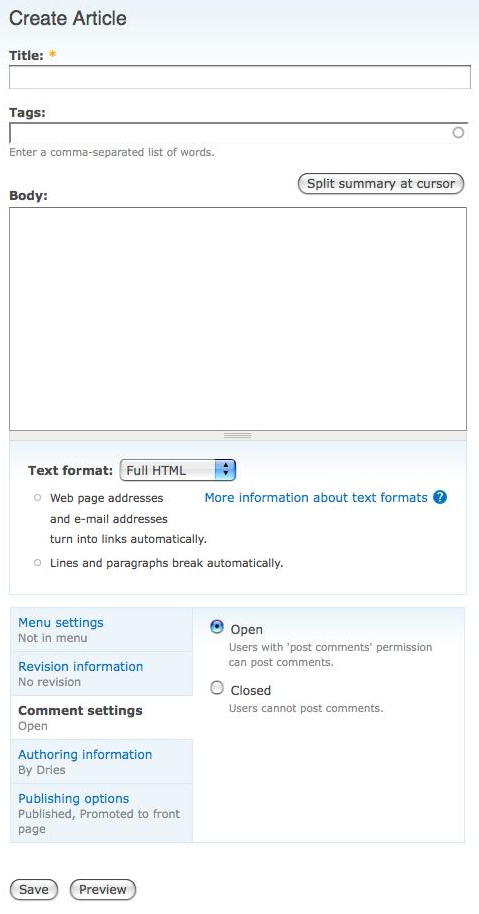
The good news is that thanks to the hard work of many people in the community, a lot of great Drupal usability improvements have already gone into Drupal 7. For example, we improved support for WYSIWYG editors, added more drag-and-drop, improved administration of permissions, added a default install profile which starts to configure some sensible defaults for Drupal as a publishing system, improved the password strength validator, redesigned and simplified various configuration pages, implemented "vertical tabs" on content creation and editing forms (see screenshot below), removed extraneous interface text, and much more.
The more important trend, however, is that after years of tireless evangelizing, the Drupal community is starting to value usability increasingly more. Today, theusability team is more involved in the patch review process than ever before -- for example, Bojhan, a usability expert active in Drupal's usability team, has even learned how to create patches so that he can help make simple changes. Another good example, is that in the Drupal 7 development cycle, we have raised money to do formal usability testing. These efforts illustrate a fundamental underlying desire to get better at usability, so I expect to see even more great things in the months to come.
Vertical tabs
The current node edit form in Drupal 7, the next major version of Drupal that is currently under development. Note the improved text format selector and the vertical tabs near the bottom. The "vertical tabs" show different groups of settings along with a summary.
All this is great work that helps address some of Drupal's fundamental problems; however, a lot of these improvements are incremental -- making incremental improvements is what the Drupal community excels at. Making the drastic over-arching improvements to Drupal's ease of use that we really need for Drupal to grow its audience requires one to step back, take a fresh look at the big picture, interview people, analyze problems, and propose more radical changes that incorporate piles of feedback and ideas. Needless to say, this is a long and expensive process, and not something we'd be able to get to using incremental changes. An objective without strategy remains a dream so as I announced in February 2009, I thought it would be right for Acquia to financeMark Boulton and Leisa Reichelt to help the Drupal community with exactly this.
For about 3 months now, Mark and Leisa have been working with the Drupal usability group and the larger Drupal community to figure out how we can improve the usability of Drupal 7. I figured an update was in order.
Mark and Leisa's work is being done in an open, collaborative, and transparent way, involving everyone in the Drupal community. The work is happening in a number of locations, and the best place to keep track of it all is at D7UX.org. Mark and Leisa also often hang out with the usability team on #drupal-usabilityon irc.freenode.net, and even have been known to venture into #drupal and#drupal-dev.
Some of the activities to date have included some 'blue sky design workshops' with community members at DrupalCon DC, one on one interviews a range of members of the the Drupal community and many potential future Drupal users, asking you to share the Drupal administration modifications you're already made and others you'd like to see made. As the work has progressed they haveshared work in progress on Flickrshared ideas, process and prototypes in videos on YouTube, conducted user testing on those prototypes (and reviewed some of your findings through crowdsourced usability testing), and much more.
Mbd header mockup
A Mark Boulton mockup of the "header" that we might see in Drupal 7.
In addition to paying Mark and Leisa, Acquia has contributed some of its own internal engineering resources. Jeff Noyes, Jason Reed (both senior designers) and myself traveled to meet with Mark and Leisa in London -- we flew in Yoroy, a key contributor to Drupal usability, to attend as well. We locked ourselves in a room for two days, and discussed and validated early design prototypes. You can read a summary of the visit on Jeff Noyes's site. Returning home from London, I couldn't be happier, because the designs and prototypes started to live up my vision and expectations of how easy to use Drupal could be.
Since then, Mark and Leisa have revised many of their prototypes based on the feedback that was provided, and continues to be provided by the larger Drupal community. The latest versions are available from D7UX.org. They aren't finished yet, but Mark and Leisa will be helping us until the end of July. Expect more mockups, working prototypes and lots of user testing and iterations. Eventually, we should also have some style guides. If you're interested in participating (and the more people who participate, the better Drupal 7 will be), you can view a list of current activities as well as well as the project framework, where the current thinking around 14 separate topics is being centrally collected and discussed.
However, beautiful usability improvements are no good to anyone unless they have code behind them. In my next blog post, I'll write about the next steps, and how we can all help translate these mockups into working code.

Usability, usability, and usability


The Interaction Design and Information Architecture program at the University of Baltimore and a team of eight graduate students have completed a usability study on Drupal. The result is a great report (PDF) and an incredibly valuable video which they shared on drupal.org. It is too important not to share, so the video is also embedded below.
The results can't be ignored.
I printed the report, taped it on my wall, and I won't release Drupal 7 until I crossed of at least 90% of the problems they identified.

Mobile for Drupal 8


In my State of Drupal keynote in Chicago I said: "If I were to start Drupal from scratch today, I'd build it for mobile experiences first, and desktop experience second.". I believe in that more than ever.
We already have a number of initiatives under way that will make Drupal a great platform for building native mobile applications (e.g. the Web services initiative) as well for building mobile web experiences (e.g. the HTML5 initiative and theDesign initiative).
However, there is more that needs to be done to make Drupal a go to platform in a mobile world. For example, a couple of weeks ago I talked to a number of big media companies, each employing hundreds of editorial staff. They all believed that in less than two years, most of their editors that report from the field will be using tablets instead of laptops. Applied to Drupal, this means we need to make the Drupal administration back-end and the editorial experience mobile-friendly, something that isn't covered by the existing Drupal 8 initiatives. Another example would be responsive web design.
The mobile internet is coming at us fast and furious. We need to move fast and we might only get one shot at this. I want to make mobile the big theme for Drupal 8. That is why I decided to launch another initiative related to mobile.
I've asked John Albin Wilkins to be the Initiative Owner for the Drupal 8 Mobile Initiative, and to work with the existing initiatives to fill the remaining gaps. To learn what that means, please consult John's announcement blog post, which includes an overview of the initiatives' goals. Like with any of these initiatives, they don't actually materialize unless people decide to help. To get involved, please join the discussions in the Mobile group on groups.drupal.org and help work on Mobile issues on drupal.org.